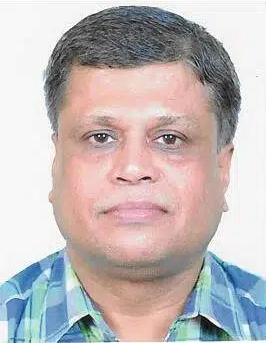
Dr. Prantik Mandal (b. 1965) received his M.Sc. (Tech.) in Applied Geophysics from the Indian School of Mines, Dhanbad, Jharkhand, India. He joined the CSIR–National Geophysical Research Institute (NGRI), Hyderabad, in 1989 for his doctoral research and was awarded a Ph.D. in Geophysics by Osmania University. In 1994, he entered the scientific cadre at CSIR-NGRI as Scientist-B and rose steadily to the rank of Chief Scientist in 2015. Following his superannuation from active service in February 2025, Dr. Mandal assumed the prestigious DAE–Raja Ramanna Chair position at CSIR-NGRI in May 2025.
Over the course of his distinguished career, Dr. Mandal has made profound contributions to understanding earthquake genesis and lithospheric dynamics across the Indian subcontinent. His pioneering studies in the Uttarakhand Himalaya delineated three NNE–SSW trending lithospheric transverse zones, segmenting the region into three major lithospheric blocks and offering an improved perspective for seismic hazard zonation across the Himalaya. Through dynamic fault-block modeling, he quantified the maximum seismic hazard within the central Himalayan gap and delineated lower hazard potential in the Kashmir and Assam sectors.
In the tectonically complex Kachchh Rift Basin, Dr. Mandal established the pivotal role of mafic crustal plutons and pronounced crustal and lithospheric thinning as key stress concentrators. His work elucidated how earthquake triggering in such regions is governed by stress-transfer processes and fluid- or CO₂-mediated mechanisms. He developed the first integrated seismic hazard framework for Kachchh, including a three-dimensional ground motion model, site amplification map, sediment thickness distribution, and attenuation characteristics—marking a major advance in regional disaster mitigation strategies.
Dr. Mandal’s investigations extended to the Eastern Indian Craton, where he demonstrated that vertical tectonics of Archean age exerted dominant control over crustal evolution. His rupture nucleation model for moderate-sized reservoir-triggered earthquakes, validated through decades of Koyna seismicity, offered a compelling mechanism whereby foreshocks initiate at shallow depths (~3 km) and propagate downward, culminating in main shocks at 8–10 km. This model has been granted a U.S. patent by the USPTO. Furthermore, his 3-D stress modeling studies quantitatively revealed how topographic relief and density heterogeneities govern the genesis of intraplate earthquakes across the Indian plate.
With a prolific record of over 140 research publications, Dr. Mandal’s work has garnered 3296 citations, yielding an h-index of 35 and an i10-index of 86. Under his mentorship, seven doctoral scholars have successfully completed their Ph.D.s in seismology. He is also the author of two books and contributor to three book chapters, reflecting his broad scientific vision.
Dr. Mandal’s contributions have been widely recognized through numerous national and international honors. He received the CSIR Young Scientist Award (2000), the National Mineral Award (2007), and prestigious fellowships including the CSIR Raman Fellowship (2004), DAAD Senior Fellowship (2010), and INSA–JSPS Fellowship (2011). He has been elected Fellow of the Indian National Science Academy (FNA, 2023), Fellow of the National Academy of Sciences, India (FNASc, 2020), and Fellow of the Telangana Academy of Sciences (FTAS, 2018).
Through a lifetime of insightful investigation, Dr. Mandal has elucidated the complex interplay between lithospheric structure, stress distribution, and seismic initiation processes—advancing our understanding of the physical basis of intraplate earthquakes in the Indian subcontinent.